
- Home
-
Destinations
BROWSE OUR AFRICA SAFARI DESTINATIONS
- Safaris
- Safari Experiences
- About Us
- Contact Us
The most important attractions in Kigali are the Kigali Genocide Memorial, the Kandt House Museum, the Inema Arts Centre, Kimironko Market and the community walking tours of Nyamirambo, most of them close enough to cover on a single Kigali city tour of a day or two. Entry runs from free to a few dollars, and there is no need to book weeks ahead. Kigali is Rwanda’s capital, set across a run of hills at the centre of the country, known for being clean, orderly and safe, which makes it an easy base for a wider Rwanda trip.
Most people start their Kigali city tour at the Kigali Genocide Memorial in Gisozi, and it sets the tone for everything that follows. This is the resting place of more than 250,000 people killed in the 1994 genocide against the Tutsi, and it is a working cemetery as much as a museum. Inside, three permanent exhibitions walk you through the history that led to 1994, a room dedicated to the children who died, and a wider display on genocides elsewhere in the world.
Entry is free. Audio guides and staff led tours are available for a small charge, and some of the guides are survivors, which changes how the visit lands. Photography is not permitted inside the exhibition rooms, though you can take your time outside in the memorial gardens where the mass graves lie. Allow around two hours. The site sits about ten minutes from the centre of town, and it opens later on the last Saturday of each month because of Umuganda, the national community work morning. Dress modestly. This is not a normal tourist stop, and it does not pretend to be one.
A short ride from the centre, the Kandt House Museum tour fills in the part of Rwanda’s past that predates the memorial. The building was the home of Richard Kandt, the German explorer and first colonial resident who set up Kigali as an administrative post around the turn of the last century, and it is one of the few structures left from that period. The rooms move through pre colonial Rwandan life, the German and Belgian colonial years, and the story of Kigali itself from village to capital.
Out the back there is a smaller section with live snakes and a young crocodile, plus one of the better views over the older part of the city. It is a compact museum, and most visitors spend thirty to sixty minutes here, so it slots neatly alongside a market or gallery stop on the same morning.
Kigali has grown a real contemporary art scene, and an art gallery tour around it is one of the easier pleasures in the city. The Inema Arts Centre is the anchor, founded by the brothers Emmanuel Nkuranga and Innocent Nkurunziza as a studio and gallery where resident artists work in the open, sell straight off the wall, and run workshops for children and adults. You can wander through for free, watch painters at work, and pick up a piece if something catches you.
If you have the appetite for more, Niyo Arts Gallery and Ivuka Arts sit within the same orbit, and Caplaki Craft Village is the place for woven baskets, carvings and jewellery under one roof. None of it takes long, and it is a gentler counterweight to the heavier history sites.
For everyday Kigali, the Kimironko Market shopping tour is hard to beat. It is the largest market in the city, a covered warehouse complex with four entrances, each leading into a different world: fresh produce and spices on one side, meat and lake fish on another, racks of second hand clothing further round, and, the part most visitors come for, rows of kitenge fabric in every pattern. Buy a few metres and one of the market seamstresses will run up a shirt or a dress while you wait.
Bring Rwandan francs rather than relying on cards, keep your phone and cash close in the busier aisles, and settle on a price before any tailoring starts. If the layout feels like a maze, a small tip to a helper near the entrance buys you a guide through it and usually a fairer opening price too.
The market runs from around eight in the morning to seven at night. Mondays and Saturdays are the busiest, Sundays the quietest, with a fair few stalls shut.
The Nyamirambo walking tour takes you into the oldest and liveliest quarter of Kigali, home to much of the city’s Muslim community and most of its nightlife. The best way in is the community tour run by the Nyamirambo Women’s Center, started in 2007 by a group of local women to fund education and training in the neighbourhood. It runs about two and a half hours on foot.
Along the way you stop into a hairdressing salon where you can sit for a braid, pound cassava leaves in a family compound, pass two mosques and a lookout over the rooftops, and finish with a home cooked lunch. The profits go back into the centre’s classes and the women who guide you, so the money stays local.
It is one of the few city tours where the walk itself, and the people you meet on it, matter more than any single sight.
Wear proper shoes. Nyamirambo is hilly and some of the lanes are cobbled.
Quieter and often missed, the Belgian Peacekeepers Memorial at Camp Kigali sits close to the centre and pairs naturally with the Genocide Memorial for anyone following the history. Ten stone columns stand in a row, one for each of the ten Belgian United Nations soldiers killed here at the start of the 1994 genocide while guarding the prime minister, Agathe Uwilingiyimana. Each pillar carries cut marks that mark the age of the man it remembers.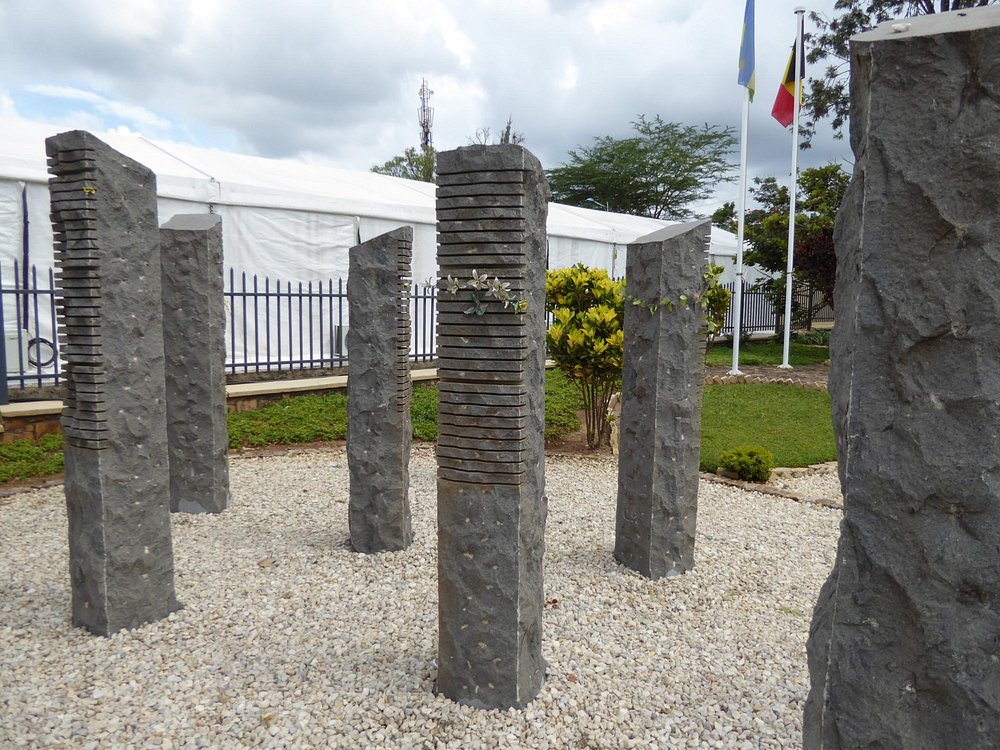
A small museum on site explains what happened and how it fits the wider collapse of that April. The visit is brief and sobering, and it puts a human scale on events that are otherwise hard to hold in the mind.
For a lighter end to a Kigali city tour, two landmarks work well together after the museums close. The Kigali Convention Centre is the domed building you will have spotted on the skyline, its shape drawn from the beehive form of the old King’s Palace at Nyanza. By day it reads as a conference venue, which it is. After dark it comes alive, lit in shifting colours that carry across the hills, and this is the time to see it, since there is little for a visitor to do inside.
Nearby, Mount Kigali gives you the wider view. A gentle climb starting up from Nyamirambo brings you to a wooded top with a bar or two and the whole city laid out below, which is a fine place to watch the light go at the end of the day.
Kigali International Airport sits about five kilometres east of the centre in Kanombe, and it is the main gateway for most travellers. Rwanda issues a visa on arrival to every nationality, so you clear immigration and step out without paperwork arranged in advance, though the fee side of that is worth checking below. Land borders with Uganda, Tanzania, Burundi and the Democratic Republic of Congo are open for overland arrivals too.
Around town, metered taxis, moto taxis and the Yego ride app cover most needs, and the central roads are good. Kigali also works as the hinge of a longer Rwanda trip: Volcanoes National Park for gorilla trekking and Akagera National Park for a savanna safari are each roughly two and a half hours away by road, which is why so many itineraries begin and end here.
Kigali holds a mild highland climate through the year, with daytime temperatures usually in the mid to high twenties and cool evenings, so the city rarely feels too hot for walking. The comfortable stretches are the two dry spells: the long dry season from June to September, and the shorter one from mid December into February. Trails on Mount Kigali and the streets of Nyamirambo are easier underfoot then.
The long rains fall from March to May and the short rains around October and November, but even then the downpours tend to come in bursts rather than lasting all day. Since most of Kigali’s attractions are indoor museums, galleries and covered markets, the weather shapes comfort more than access, and any month of the year gives you a full trip.
Yes. Entry is free and the memorial runs on donations, with a box near the exit. If you want more depth you can hire an audio guide or join a staff led tour, some of them led by survivors, for a small charge. Photography is not allowed inside the exhibition rooms, though it is fine in the gardens.
Non residents pay around RWF 6,000, roughly US$8, while visitors holding a Rwandan residence permit pay a little less, about RWF 5,000. The ticket covers both the indoor history rooms and the outdoor reptile section, and a guide is usually included.
The community walking tour with the Nyamirambo Women’s Center costs about $15 to $20 per person for roughly two and a half hours, with a few extra dollars if you add the home cooked lunch, which most people find worth it. Booking a day or two ahead by message is the norm, and the money supports the centre’s training work.
Rwanda grants a visa on arrival to every nationality at the airport and at land borders. The standard visitor visa is about $50 single entry or $70 multiple entry for thirty days, and citizens of African Union and East African Community countries enter free. If you are also visiting Kenya and Uganda on the same trip, the East Africa Tourist Visa can work out cheaper than separate visas.
One full day covers the Genocide Memorial, a museum and a market. Two days let you add the art galleries, a Nyamirambo walk and a look at the Convention Centre after dark. Most travellers treat Kigali as the start or end of a wider Rwanda trip rather than the whole holiday, since the parks are a couple of hours out.
Kigali has a strong name as one of the cleaner and safer capitals in Africa, and walking the central areas by day is comfortable. Ordinary care still applies in crowded places like Kimironko Market, where you keep your phone and cash close and agree a price before you buy.
A city stop is a small part of a bigger plan, and how you shape your days in Kigali, and what you go on to see afterwards, stays yours to decide. Ancient Africa Safaris is owner led and East Africa is all we do, so you deal with people who know these places first hand and will tell you plainly which stops earn your time and which you can skip. Once you decide to go ahead, the permits, transfers and the fine detail are quietly ours to carry.
There is no rush. Whenever the time feels right, write to us at Ancient Africa Safaris, and one of our team will reply in person.
Ready to see it for yourself?
START PLANNING MY SAFARI