
- Home
-
Destinations
BROWSE OUR AFRICA SAFARI DESTINATIONS
- Safaris
- Safari Experiences
- About Us
- Contact Us
A Great Migration safari follows the year-round movement of well over a million wildebeest, with hundreds of thousands of zebra and gazelle, in a slow loop through the Serengeti in Tanzania and the Maasai Mara in Kenya. The herds chase the rains and fresh grass, so the spectacle is somewhere in the ecosystem in every month, not just during the famous river crossings. Where you go and when you travel decide whether you catch the calving, the crossings or the long marching columns in between.
The sections below walk through the cycle phase by phase, so you can match a trip to the part of the migration you most want to see.
The wildebeest migration is the largest overland movement of animals on the planet, a roughly circular route of about 800 kilometres driven by rainfall and grazing rather than any fixed calendar. Alongside the wildebeest travel some 200,000 zebra and several hundred thousand gazelle, grazing and being hunted the whole way round. The wildebeest is the animal the system turns on, and its numbers have long been quoted at around 1.5 million.
That figure is worth a note. It has been the accepted count for decades, drawn from aerial surveys, but a recent satellite and AI study has prompted scientists to re-examine the true total, and the question is not yet settled. What is not in doubt is the scale of what you see on the ground, which remains one of the great wildlife spectacles anywhere.
The whole loop sits inside the Serengeti-Mara ecosystem, a protected block of around 25,000 to 30,000 square kilometres that carries UNESCO World Heritage status on the Tanzanian side. Because the herds are always moving, a Great Migration safari is really a matter of reading where they will be and putting you in the right region at the right time.
The year opens with birth. From roughly January to March the herds gather on the short-grass plains of the southern Serengeti and Ndutu, drawn by grass grown rich on volcanic soil, and a calving season safari here lands you in the middle of it. February is the peak, when something close to half a million calves arrive inside a few short weeks, at times several thousand in a single day.
A newborn wildebeest is on its feet within minutes, which it needs to be, because the open plains that make the calves easy to raise also make them easy to hunt. This is the strongest stretch of the year for predators. Lion, cheetah and hyena work the herds in the open, and the flat, treeless country gives long, clear sightlines, so the big-cat action is easier to watch here than almost anywhere else on the circuit. In the Ndutu area guides can drive off-road, which helps get you into position without crowding the animals.
As the southern plains dry out around April and May, the herds begin moving north and west in long columns, and the rut sets in, with males sparring and calling across the grass. By June much of the migration has massed in the Serengeti’s Western Corridor, where the Grumeti River forms the first real barrier of the year.
A Grumeti crossing safari is quieter and less frantic than the Mara crossings that follow. The Grumeti is often a chain of pools rather than a single broad river, and while large crocodiles wait in it, the crossings tend to be smaller and less crowded with vehicles. For travellers who want migration drama without the peak-season numbers, the Western Corridor in June is an underrated window.
This is the one most people picture. From around July, the herds push into the northern Serengeti, and the Mara River crossings begin, running through to about October. A Mara River crossing safari puts you on the banks where thousands of wildebeest pile up, hesitate, then pour down a steep bank into water full of crocodiles, some of them well over five metres long.
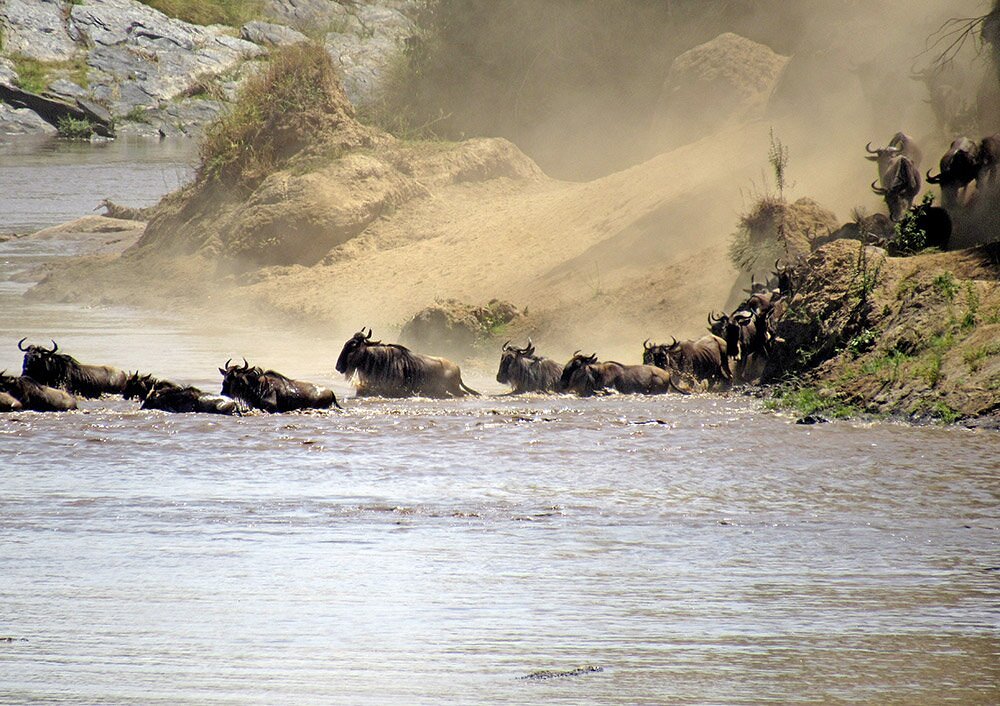
The crossings are chaotic and hard to predict. Herds gather at the water’s edge and wait, sometimes for hours, until a single animal commits and the rest follow in a stampede, and they may cross back and forth over several days. The Tanzanian side around Kogatende and the Lamai Wedge holds strong crossing points, and the northern Serengeti is usually less crowded than the Kenyan bank. Nothing about a crossing is scheduled, so the honest advice is to base near the river and give yourself several nights rather than a single lucky afternoon.
River crossings are never guaranteed. They hinge on rainfall, grass and the herd’s own mood, and no guide can promise one on a given day. Allowing five to seven nights near the river through the crossing months, rather than a quick overnight, is the single biggest thing you can do to improve your odds.
When the herds cross the border, a Great Migration safari moves into Kenya’s Maasai Mara, where the action is strongest from about August to October. The Mara River continues to stage crossings on this side, and the reserve’s open grassland makes for superb general game viewing on top of the migration itself.
The Mara is smaller than the Serengeti and can draw a lot of vehicles at a good crossing, so the private conservancies bordering the reserve, places like Mara North and Naboisho, are worth weighing up. They hold the same wildlife with far fewer cars, and they permit off-road driving and night drives that the main reserve does not. One common misunderstanding is worth clearing up: only part of the herd crosses fully into Kenya, and many wildebeest linger and cross back on the Tanzanian side, so both countries offer the migration through these months rather than one holding all of it.
The cycle is best understood as a rough calendar, with the firm caveat that every date moves by days or weeks with the rains and can differ from one year to the next. No two seasons run to exactly the same schedule.
January to March: calving on the southern Serengeti and Ndutu plains, peaking in February, with intense predator activity on the open short grass.
April to June: the herds move north and west through central Serengeti as the rut begins, massing in the Western Corridor for the Grumeti crossings around June.
July to October: the northern Serengeti and Maasai Mara, with the Mara River crossings at their strongest, often peaking in August and September.
November to December: the short rains pull the herds back south toward the calving grounds, and the loop begins again.
Read that as a pattern, not a promise. In a year with early or late rains the herds can be well ahead of or behind the usual position, which is exactly why timing and camp placement matter so much on a migration trip.
The migration is the headline, but it is not the whole show. The Serengeti and the Mara both hold large resident populations that stay put all year, so a Serengeti safari is rewarding whenever you travel, even between the migration’s big set pieces.
Resident lion prides, leopard along the rivers and rocky kopjes, elephant, giraffe and buffalo are here in every month, which is why the Serengeti works just and a classic big-game safari as it does a migration one. The ecosystem carries some of the densest big-cat numbers in Africa precisely because the migration feeds the predators that follow it. Travellers who visit outside the crossing and calving windows sometimes arrive braced for disappointment and leave surprised by how much game they saw. The wildebeest come and go; the lions do not.
For a different angle on the herds, a hot air balloon safari lifts off before dawn and drifts low over the plains as the light comes up. Floating above a moving column of wildebeest, or over the Mara River as the herds gather, is a view no game drive gives, and the flight usually ends with a bush breakfast out on the grass.
Balloons launch mainly from the central Serengeti around Seronera and from the north near Kogatende, so pairing the flight with the phase of the migration in that region takes a little planning. It is the signature splurge of a migration trip, and one many travellers rate as the highlight of the whole safari.
There is no single best month, only the best month for what you want to see. If the river crossings are the goal, aim for roughly July to October, with August and September the strongest, though also the busiest. If it is the calving and the big-cat action, February in the southern Serengeti is hard to beat, and it draws fewer crowds than the crossing season.
Because the timing moves with the rains, a little flexibility helps, and so does trusting camp placement over a fixed date. September often delivers strong crossings with thinner crowds than August, which makes it a quiet favourite among people who have done the trip before. Whatever the month, the resident game means the safari stands on its own even if the herds have shifted on.
The last planning question is usually which country to watch from. The Serengeti in Tanzania covers the calving grounds, the Grumeti crossings and the northern Mara River crossings, so it can carry a migration trip across most of the year. Kenya’s Maasai Mara comes into its own from August to October, when the herds are on that side and the crossings are in full swing.
Serengeti, Tanzania: the widest choice of migration phases across the year, from calving in the south to crossings in the north, over a much larger area with strong year-round game.
Maasai Mara, Kenya: best from August to October for the Mara River crossings, in a smaller reserve; the bordering conservancies trade crowds for off-road driving and night drives.
Mobile camps that relocate with the seasons, moving south for the calving and north for the crossings, put you closest to the herds, while permanent lodges suit travellers who want a fixed base. Either way, the crossing and calving months book up far ahead, so the earlier a migration trip is planned, the better placed you are.
Migration trips sit at the higher end of safari pricing because they run in prime season and often use camps close to the herds. As a rough guide, most come in from around US$800 to well over $1,000 per person per day once accommodation, park fees, guiding and transfers are counted, with mobile camps in the crossing and calving months at the upper end. Park entry to the Serengeti currently runs about $60 to $70 per person per day. Prices move with the season and the tier of camp, so treat these as indicative rather than fixed.
The Mara River crossings in the northern Serengeti and the Maasai Mara are usually strongest from about July to October, often peaking in August and September. The earlier Grumeti crossings in the Western Corridor happen around June and are quieter. All of these windows move with the rains, so they are patterns rather than fixed dates, and no crossing can be promised on a given day.
No. Crossings depend on rainfall, grazing and the herd’s own behaviour, and animals may wait at the bank for hours or days before committing. Being in the right region during the crossing months, and staying several nights rather than one, is the best way to improve your chances, but nothing about a crossing runs to a schedule.
Five to seven nights is a sensible target, especially for the crossings, since their unpredictable timing needs a buffer. Spending at least three nights in one region, close to where the herds are that month, gives you far better odds than moving every day. A shorter trip can still work for the calving, which is more concentrated in one area.
Yes. A dawn hot air balloon safari over the Serengeti typically costs around $550 to $650 per person, including the park ballooning fee, and runs for about an hour before a bush breakfast on the plains. Flights launch from the central and northern Serengeti, so it is worth matching the launch area to where the migration is that month. Book well ahead, as places are limited.
Easily. On the northern circuit the migration pairs naturally with Ngorongoro Crater, Tarangire and Lake Manyara, and many trips add a Zanzibar beach extension afterwards. On the Kenyan side the Maasai Mara combines with Amboseli and Lake Nakuru. A good operator will shape the route around the migration’s likely position for your dates.
Ancient Africa Safaris is owner-led, and East African wildlife travel is what we do, so a migration trip is planned by people who track where the herds actually are rather than working off a printed calendar. We will be straight with you about what the season can offer, put you in the right region for the crossings or the calving, and set honest expectations about the parts no one can guarantee. Once you decide to go ahead, the camps, the park bookings and the timing become ours to handle.
There is no rush. Whenever the moment feels right, write to Ancient Africa Safaris, and one of our team will reply to you in person.
Add a Serengeti property for the southern leg and calving season.
Ready to see it for yourself?
START PLANNING MY SAFARI